


Table of Contents
A good digital marketing strategy is all about spending the money wisely.
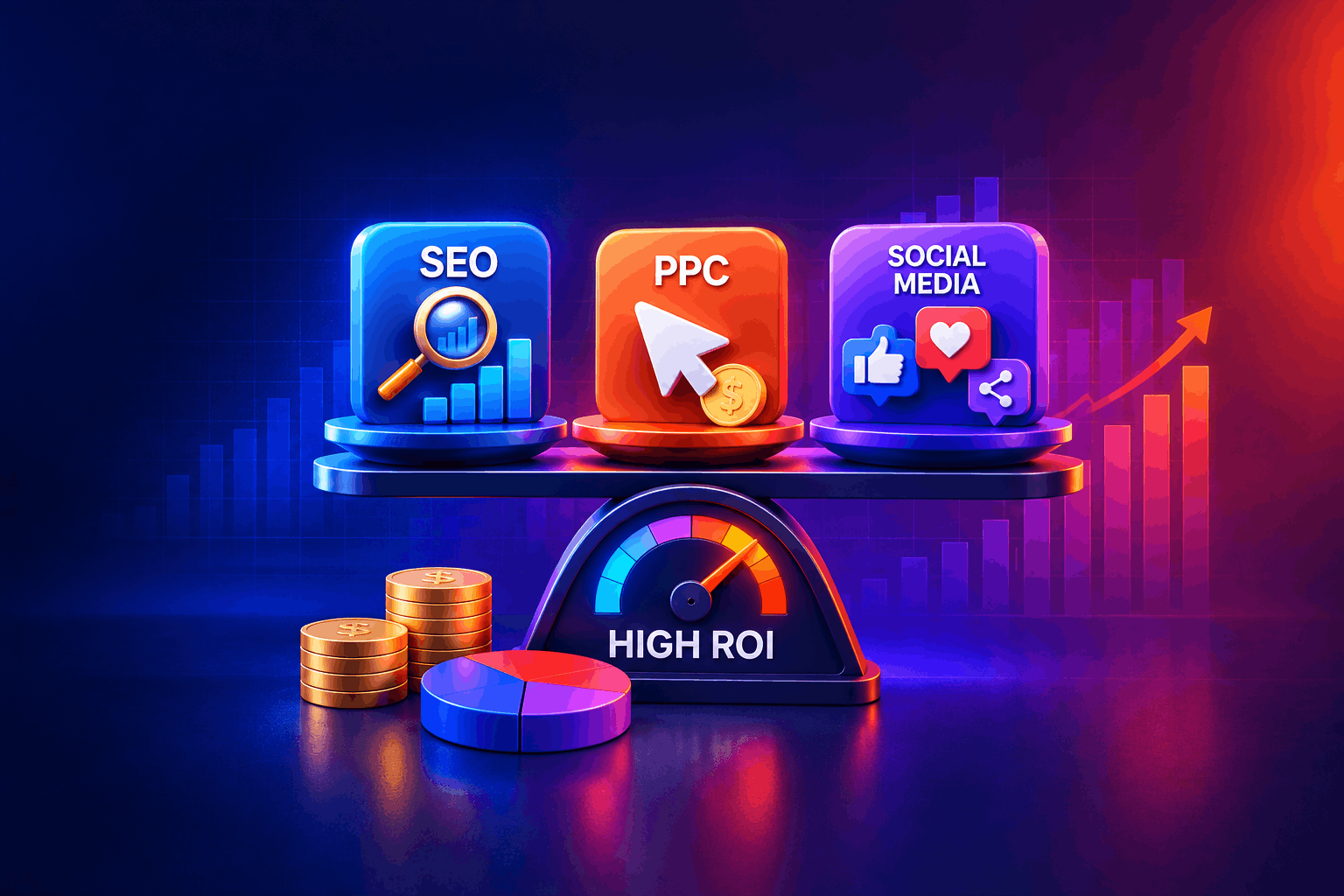
High-ROI companies do not focus on SEO, PPC or social media alone. They understand that marketing budget allocation should be based on their business, their audience and their performance. But how do they decide what to spend their money on?
Why is Marketing Budget Allocation Important?
Marketing channels have different benefits, which makes marketing budget allocation an important part of a successful digital marketing strategy.
- SEO is an investment in their long-term visibility and attracting traffic through search engines.
- PPC is perfect for visibility and targeting people who actively search for specific services or products.
- Social media is an asset for building awareness, engaging the audience and reaching out with content to boost a brand’s visibility.
The emphasis should not be on equal budget distribution, but rather on understanding how each channel could impact their growth. Effective marketing budget allocation allows businesses to make better use of their available resources.
1. They Don’t Split Budgets Equally
There is nothing wrong in splitting the budget percentages equally among SEO, PPC and social media.
However, high-ROI companies factor in the most relevant marketing channels for their business. Their marketing budget allocation is based on what their business needs rather than simply dividing the budget equally.
For instance, different amounts of money could be invested in SEO and PPC depending on their goals, audience, competition, customer acquisition cost, conversion rate, sales cycle and past performance.
The allocation of the company’s budget depends on:
- Business goals
- Target audience
- Level of competition
- Customer acquisition cost
- Conversion rate and sales cycle
- Past performance
Each business will have a different allocation depending on the combination of the aforementioned factors. This is why there is no single approach to marketing budget allocation that works for every business.
2. They Use SEO for Long-Term Gains
SEO is a wise investment for the future.
Organizations utilize SEO to boost their organic visibility which, in turn, attracts new customers and enhances website performance.
SEO is about investing in making the website attractive to Google and other search engines.
Although SEO is a fantastic way to get long-term visibility, it has a learning curve that requires resources and effort to yield results.
That is why high-ROI companies are all about continuous improvement. As part of their marketing budget allocation, they continue investing in SEO when organic growth supports their long-term goals.
3. They Use PPC to Target Customers Searching for Their Service
PPC could bring the best value if businesses harness the power of intent.
For instance, Google Ads can help them tap into people searching for services related to their business.
PPC can be a hit for:
- Generating high-quality leads
- Selling specific services
- Releasing new offers
- Capturing high-intent customers
- Driving traffic to landing pages
Although the idea of boosting their PPC budget sounds like a good idea, companies should factor in a variety of factors.
These include the cost per lead, conversion rate, cost of customer acquisition and return on ad spend, among others.
These factors help businesses determine whether their marketing budget allocation towards PPC is generating the expected results.
4. They Use Social Media to Build Interest for Their Brand
Social media channels have a different role than PPC and SEO.
Although the latter two are meant for getting visibility and customers, social media is about building interest ahead of people visiting their website.
For instance:
Social Media Marketing → Awareness → Website → Retargeting → Conversion
Social media marketing allows them to offer value to their audience, position themselves as an authority in the niche and attract customers.
That is why high-ROI companies evaluate a plethora of factors when measuring social media performance.
Instead of just looking at likes, comments, shares and followers, businesses should also consider assisted conversions and the impact on the website’s traffic.
These insights can help businesses determine how social media should fit into their overall marketing budget allocation.
5. They Base Their Decisions on Data
High-ROI companies regularly look at their marketing data rather than making random adjustments.
They study the performance of each marketing channel in terms of:
- Customer acquisition cost: How much does it cost to acquire one customer?
- Conversion rate: What percentage of visitors are converting?
- Cost per lead: How much does the business spend on one lead?
- ROAS: How much revenue is being generated from the marketing spend?
- Organic traffic: How many visitors are coming from search engines?
- Revenue: How much money is being made?
Companies could measure whether each channel is worth the investment based on these numbers.
Using these figures allows companies to make more informed marketing budget allocation decisions rather than making random changes to their marketing spend.
6. They Reallocate More Money to the Best-Performing Channels
Businesses shouldn’t keep a static budget allocation.
If a certain channel is not performing well, the company should think about reallocation of some of the money to the marketing channels that are yielding better results.
For instance, if a business is spending $3,000 monthly on a social media campaign that is not bringing any leads or revenue, they can use this money to invest in other areas such as SEO or PPC.
On the other hand, businesses could boost their budget for the best-performing channels.
If their SEO articles are generating great traffic, it might be a good time to invest more in SEO.
The point is not to chase equality, but rather to make the most of their available budget. Effective marketing budget allocation should remain flexible and change according to performance.
A Simple Example
Let us say that a business has a $10,000 monthly budget for digital marketing.
A possible marketing budget allocation could be:
| Channel | Budget | Goal |
|---|---|---|
| PPC | $4,000 | Drive leads |
| SEO | $3,500 | Improve organic visibility |
| Social Media | $2,500 | Create brand awareness |
It’s worth noting that this is just an example and different companies will prioritize different marketing channels.
After the initial allocation, businesses can make the adjustments based on performance data. This allows them to continuously improve their marketing budget allocation and put more resources into the channels that deliver stronger results.
Conclusion
The best way to approach marketing budget allocation isn’t about spending equally across SEO, PPC and social media. It’s about using data, understanding your audience, and investing more in the channels that drive meaningful results.
A high-ROI digital marketing strategy is built on balance, performance, and continuous optimization, not simply spending more. If you want expert help creating a data-driven strategy that maximizes your marketing ROI, contact us and let’s turn your marketing spend into sustainable growth.
Liked what you read? This is just a glimpse of how we think. Reach out and let’s talk about what we can build for your business.
Contact Us