

Table of Contents
Online shopping is changing. Customers can describe a need to an AI assistant, compare products in a conversation, and move toward a purchase without browsing dozens of category pages. Ecommerce businesses must now consider how to make product, checkout, payment, and order information available to AI shopping experiences.
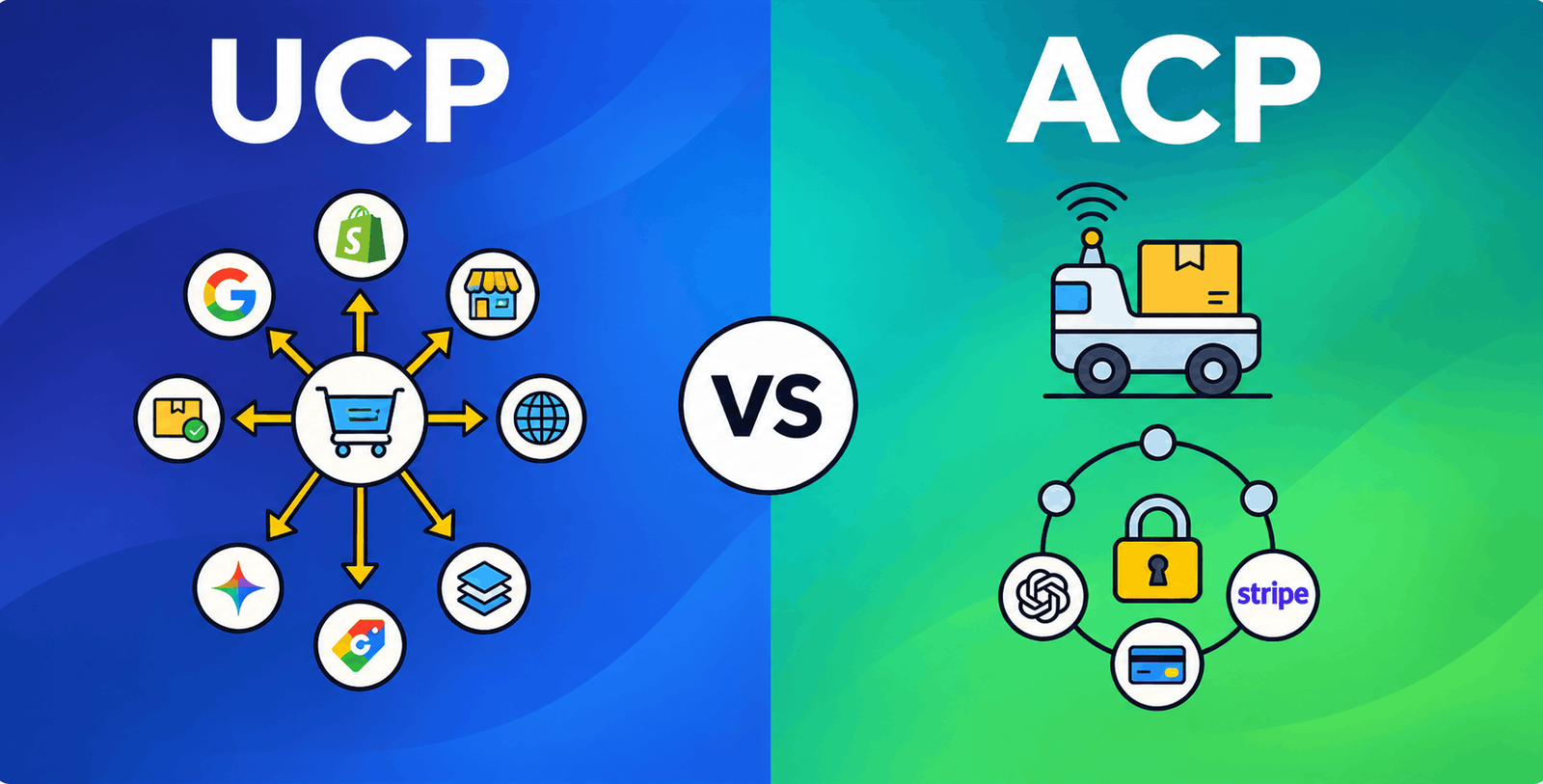
Two standards are central to this shift: the Agentic Commerce Protocol (ACP), associated with OpenAI and Stripe, and the Universal Commerce Protocol (UCP), co-developed by Google, Shopify, and other commerce participants. Both reduce one-off connections between merchants and AI platforms, but their scope differs. ACP vs UCP is an infrastructure decision, not just a label. Understanding ACP vs UCP helps retailers choose where to invest and what systems to prepare.
This guide compares ACP vs UCP capabilities, implementation requirements, limitations, and practical value for online stores. A sound ACP vs UCP decision starts with the customer journey.
Quick Overview
ACP connects AI agents, shoppers, and merchants through structured commerce data and transaction workflows. Its ChatGPT implementation includes product feeds, checkout sessions, payments, and order updates. UCP is a broader, capability-based standard connecting agents, businesses, and payment providers across discovery, cart, checkout, and post-purchase activities.
The key difference in ACP vs UCP is scope. A useful ACP vs UCP assessment starts with the customer journey the business wants to support. ACP is especially relevant to merchants preparing for supported ChatGPT shopping; UCP is relevant to businesses preparing for Google’s AI shopping surfaces and broader commerce capabilities. Neither replaces an ecommerce platform, guarantees recommendations, or removes the need for accurate product information. Some merchants may eventually support both. A practical ACP vs UCP assessment separates discovery requirements from transaction requirements.
What Is Agentic Commerce?
Traditional ecommerce takes shoppers from a store visit to search, product pages, cart, payment, and order confirmation.
Agentic commerce adds an AI assistant. A shopper might request an affordable suitcase suitable for international flights, with four wheels and a warranty. An agent can interpret the request, compare products, check availability, and help complete a purchase where integrations allow.
The merchant remains responsible for stock, pricing, tax, fulfillment, returns, and service. The agent needs reliable information and authorized system access. A commerce protocol supplies shared data structures and transaction rules, reducing the need for separate connections to every assistant.
ACP vs UCP therefore matters to product discovery, checkout, customer experience, and order synchronization, not just developers.
What Is the Agentic Commerce Protocol (ACP)?
The Agentic Commerce Protocol is an open specification for information exchange between buyers, AI agents, and sellers. OpenAI uses it for ChatGPT shopping, and Stripe has helped develop the protocol and payment infrastructure. In an ACP vs UCP review, ACP is a clear candidate when the starting point is ChatGPT product discovery and supported checkout.
ACP is more than a payment button. Product feeds provide identifiers, titles, descriptions, images, prices, availability, and seller details. The Agentic Checkout specification defines session creation and updates, authoritative totals, order completion, and order events.
How ACP works in a merchant setup
A merchant prepares a structured product feed with stable identifiers and accurate variant attributes. Different shirt sizes need distinct records when stock, images, or prices differ. OpenAI’s ACP getting-started guide recommends validating required fields and refreshing catalog snapshots at least daily.
For supported in-chat purchases, the merchant implements checkout endpoints. ChatGPT requests a session with selected items and buyer context. The merchant returns the authoritative cart, including discounts, shipping, taxes, fees, and totals. Changes trigger an update. After confirmation, the merchant processes payment, creates the order, and sends events through webhooks.
A merchant can retain its commerce backend and payment provider rather than rebuild its store, although integration still requires secure APIs and conformance testing. For ACP vs UCP planning, assess existing infrastructure first. ACP’s specification is public, but OpenAI limits product-feed onboarding and Instant Checkout to approved partners. Public documentation does not mean automatic activation, so confirm eligibility before setting launch expectations.
What Is the Universal Commerce Protocol (UCP)?
The Universal Commerce Protocol is an open standard co-developed by Google and partners including Shopify, Etsy, Wayfair, Target, and Walmart. It connects merchants, agents, and payment providers across discovery, purchase, and order management, including Google AI Mode and Gemini. Its broader design is important in any ACP vs UCP comparison.
UCP is modular. A business publishes a public UCP profile declaring its protocol versions, capabilities, API endpoints, payment configuration, and public keys. An agent inspects the profile and negotiates the functions both sides support.
UCP capabilities and architecture
UCP capabilities can cover checkout, fulfillment, discounts, catalog access, cart operations, identity linking, and order management. Extensions support additional business rules without requiring a new protocol for every feature.
UCP separates the payment instrument from the handler that processes it, supporting different payment methods and providers while keeping the merchant involved. In an ACP vs UCP architecture review, this separation is an important UCP distinction. It is compatible with the Agent Payments Protocol (AP2) and can use API, Model Context Protocol (MCP), or Agent2Agent (A2A) bindings where supported.
Not every capability is live on every surface. Google says UCP is evolving and some specified features are not yet available in its products. Check platform support before investing. ACP vs UCP should be assessed against functions merchants can activate today, not every capability in an open specification.
ACP vs UCP: Key Differences at a Glance
| Comparison area | ACP | UCP |
|---|---|---|
| Main ecosystem | OpenAI, Stripe, and participating commerce partners | Google, Shopify, and a wider retail and payments coalition |
| Primary emphasis | Product data and agent-led transaction workflows, including checkout | Modular commerce journey across discovery, cart, checkout, and post-purchase |
| Platform association | ChatGPT shopping and supported agent experiences | Google AI Mode, Gemini, and compatible future surfaces |
| Merchant data | Product feeds, seller details, prices, inventory, and variants | Business profile, declared capabilities, catalog information, and merchant data |
| Integration pattern | Product feed, checkout APIs, payment handling, and order events | Public capability profile plus negotiated APIs or supported protocol bindings |
| Payments | Merchant uses its payment provider; delegated payment can be supported | Payment handlers connect supported instruments and providers; AP2 compatibility is part of the design |
| Flexibility | Standardized transaction flows with an evolving set of commerce functions | Capability negotiation and extensions for multiple commerce workflows |
| Live access | Relevant ChatGPT experiences require partner approval | Google onboarding and validation are required |
This is a snapshot, not a permanent boundary. For an ACP vs UCP implementation decision, compare current specifications and release notes. As of November 10, 2026, ACP’s repository lists April 17, 2026 as its latest stable specification, while UCP’s lists August 25, 2026. Check the official ACP specification repository and UCP release history before development.
ACP vs UCP: Which Standard Should an Ecommerce Business Choose?
There is no universal winner in ACP vs UCP. The right ACP vs UCP choice depends on customer behavior, platform priorities, technical readiness, and partner access. A store with established Google Merchant Center operations may prioritize UCP differently from a brand whose customers research products in ChatGPT.

Choose ACP when ChatGPT is a priority
Prioritize ACP if customers use ChatGPT to research products or you want supported ChatGPT shopping and checkout. Review product identifiers, descriptions, variants, seller details, images, pricing, and inventory. Then check whether your platform can produce a reliable feed and expose required checkout functions. This is the practical ACP vs UCP choice when ChatGPT is the primary destination, although approval and market availability remain decisive.
For large catalogs, prioritize dimensions, materials, compatibility, sizing, and other attributes shoppers need to compare products. Accurate information matters more than promotional copy.
Choose UCP when Google’s AI commerce path is a priority
UCP is relevant to Merchant Center users preparing for AI Mode or Gemini. Google’s UCP implementation overview describes two paths: native checkout on its surfaces, or cart transfer to the merchant website to finish the purchase. For that reason, ACP vs UCP is also a question of where the final checkout experience should take place.
Review Merchant Center, product identifiers, shipping, returns, checkout APIs, and order processes. A cart-transfer integration may suit businesses with complex delivery rules or a need to retain their checkout.
When supporting both makes sense
Businesses serving several AI channels may support both standards without duplicating inventory or ecommerce platforms. Maintain one source for product, price, inventory, order, and fulfillment data, then expose it through each interface.
An integration layer can map one product record to an ACP feed and a UCP catalog capability. Each still needs its own identifiers, authentication, payment handling, and transaction logic. An ACP vs UCP strategy can share data without making the protocols interchangeable. For a multi-channel retailer, this becomes an integration roadmap decision rather than a one-time choice.
How ACP and UCP Affect Ecommerce Operations
Prioritize data accuracy. An unavailable color or a sale price that differs from checkout creates confusion. Connect feeds and APIs directly to stock and pricing systems rather than relying on manual spreadsheets.
Checkout totals must match the merchant’s cart, including shipping, taxes, discounts, and fees. Recalculate totals when quantities or delivery details change.
Connect orders to the usual processes for stock allocation, dispatch, confirmation, returns, and support. Staff should identify AI-originated orders without learning a separate workflow. These operational foundations support either side of an ACP vs UCP rollout.
Track AI-assisted visits and purchases where attribution is available. Use consistent campaign parameters and order-source fields, measuring only what each platform reports.
A Practical Implementation Plan for Merchants
Use a staged rollout. An ACP vs UCP pilot should test data quality, transaction reliability, and customer outcomes before expansion.
1. Audit the product catalog
Check identifiers, titles, descriptions, images, prices, stock, variants, shipping, and seller details. Fix inconsistencies, starting with high-volume products.
2. Establish a reliable source of truth
Define which system owns each field and how updates synchronize. Separate manual edits across websites, feeds, and spreadsheets can create conflicting records.
3. Check platform and partner eligibility
Check market availability, merchant eligibility, and existing platform or payment integrations. Verify ACP feed and checkout access or UCP integration-hub access before budgeting. A public specification does not guarantee production access.
4. Map the technical requirements
Map product and order fields to each schema. Document endpoints, authentication, payments, errors, webhooks, retries, cancellations, refunds, and failed-payment handling. Involve development, operations, ecommerce, and payment teams.
5. Test realistic customer journeys
Test variants, discounts, unavailable stock, delivery changes, taxes, payment failures, duplicate requests, and cancellations. Confirm retries do not duplicate orders and webhooks update status.
6. Launch in stages and monitor results
Start with a limited catalog. Monitor feed errors, stale inventory, checkout completion, order synchronization, and support requests before expanding.
Risks, Limitations, and Common Mistakes
Adoption does not guarantee traffic. ACP vs UCP standardizes communication with participating agents, but neither guarantees recommendations or sales. Eligibility, platform decisions, relevance, competition, and customer preferences still matter.
Weak product data is another risk. “Premium quality headphones” says little about battery life, connectivity, compatibility, warranty, or included accessories. Use factual attributes and synchronize price and stock with the live system.
Build in security. In any ACP vs UCP integration, protect credentials, verify signed requests, enforce idempotency for orders and charges, validate data, and use secure transport. Review privacy, consent, retention, payment, and consumer-protection obligations before launch.
Open specifications do not mean unrestricted access. Both programs have onboarding, validation, and surface-specific requirements. This is a key ACP vs UCP caveat: building an integration is separate from receiving permission to use a production shopping surface.

Do ACP and UCP Replace SEO and Product Structured Data?
No. SEO helps people and search systems discover websites. Structured data and merchant feeds describe products and offers; commerce protocols define how agents and merchants exchange information and complete transactions.
Google’s Product and Offer structured data guidance explains how eligible product pages communicate price and availability. An ACP vs UCP implementation should complement, not replace, these practices. Merchant Center feeds, accessible product pages, accurate information, and conventional SEO remain useful as shoppers continue using search engines and merchant websites.
An ACP feed also does not replace accurate catalog data, useful descriptions, images, seller details, or consistent pricing. It is an additional distribution and transaction layer.
Maintain accurate product information and distribute it through relevant channels. Evaluate ACP vs UCP on availability and business value, then revisit the decision as access, features, and customer behavior change.
Final Thoughts
ACP and UCP move AI commerce toward structured interactions with merchant systems. ACP offers a route into supported ChatGPT shopping, while UCP provides a broader capability model for Google’s ecosystem. Their scopes overlap, but neither replaces the other. An ACP vs UCP strategy should start with clean systems and expand only when a channel serves customer needs.
Start with accurate product data, synchronized inventory, transparent pricing, secure checkout, reliable order management, and measurable journeys. The most effective ACP vs UCP roadmap reflects those foundations and real customer demand.
Choosing a trusted digital solutions agency with proven industry experience can make all the difference when preparing your ecommerce business for AI-powered commerce. Work with experts who understand ecommerce development, API integrations, automation, and emerging technologies to build secure, scalable solutions that support your long-term business goals.
Frequently Asked Questions
1. What is the main difference between ACP and UCP?
ACP vs UCP comes down to emphasis: ACP connects agents and merchants through product data and transaction workflows, with a focus on ChatGPT shopping. UCP defines broader capabilities for discovery, cart, checkout, and post-purchase interactions, including Google AI surfaces.
2. Is ACP better than UCP for ecommerce stores?
Neither is universally better. ACP may suit merchants prioritizing ChatGPT shopping, while UCP may suit businesses preparing for AI Mode and Gemini. An ACP vs UCP decision depends on audience, access, technical requirements, and existing systems.
3. Can an ecommerce business use ACP and UCP together?
Yes. A merchant can prepare for ACP vs UCP together by maintaining one source for product, inventory, pricing, and order data, then mapping it to each protocol. Each integration still needs validation, authentication, and transaction handling.
4. Do ACP and UCP work with Shopify?
Shopify is involved in the UCP ecosystem. ACP connects merchants with supported ChatGPT shopping workflows. Shopify stores should verify current onboarding and technical requirements rather than assume automatic access.
5. Do small ecommerce businesses need to implement these protocols now?
Not necessarily. Smaller merchants should first improve catalog accuracy, product pages, inventory synchronization, checkout, and analytics. Then review ACP and UCP availability and prioritize a channel with a realistic customer opportunity.
6. Do ACP and UCP improve Google rankings or AI recommendations?
Neither guarantees rankings. UCP supports commerce interactions, while Google’s structured data and Merchant Center guidance explain product information for eligible search experiences. ACP feeds support ChatGPT product discovery, but do not guarantee recommendations or placement.
7. What technical requirements should merchants prepare for?
Prepare clean product identifiers, accurate variants, current prices and inventory, secure APIs, payment integration, order webhooks, error handling, and reliable synchronization. Review the official guide for platform-specific requirements before estimating development work.
8. Are ACP and UCP open standards?
Both are open specifications. However, live shopping surfaces may require platform approval, merchant onboarding, testing, and compliance. Open specifications do not guarantee unrestricted access to production features.