

Table of Contents
If you’ve been searching for the best chatbot solution for your business in 2026, you’ve likely come across the debate between rule-based and RAG-powered chatbots. While advocates of each approach often claim theirs is the best, the reality is that both have strengths and limitations. After years of developing chatbot solutions, I’ve learned that the right choice depends on your business needs. This guide will help you understand both approaches so you can make an informed decision.
The Rule-Based Chatbot
A rule-based chatbot is designed to respond with predefined answers to specific questions. Every response is programmed in advance, following a fixed set of rules or conversation paths. For example, it can ask for an order number to provide tracking information or guide customers through the refund process. While effective for simple, repetitive tasks, it struggles with unexpected questions or conversations outside its programmed responses.
As you can see, the rule-based approach is severely limited in its ability to tackle complex or ambiguous questions. With that said, its inability to handle unexpected or unrelated questions is also a huge advantage. The rule-based chatbots are excellent at narrow use cases where customers are only likely to ask a particular set of questions. In 2026, these types of chatbots are mostly utilized in e-commerce and banking to tackle narrow scenarios, such as order tracking or balance inquiries in a predictable manner. However, if you were to ask such a chatbot an unexpected question, it would not be able to provide you with a satisfactory answer.
The same strength can also be a significant weakness in certain contexts, as the rule-based chatbots cannot provide you with incorrect information by mistake. This makes them much more reliable and predictable than their RAG-based counterparts in certain contexts, which is why they are still utilized in highly regulated industries. There is absolutely no room for error when it comes to rule-based chatbots, which is why they are programmed in a highly deterministic manner.
Moreover, if you are looking for a chatbot that is relatively easy to implement, the rule-based chatbots are the way to go. Since every rule has to be written manually, rule-based chatbots are only utilized in specific, well-defined use cases. Additionally, when it comes to rule-based chatbots, there is no need to worry about training data, as there is no training involved; the rules are written directly by the people who will be reviewing them. This makes the creation of rule-based chatbots much more reliable and deterministic, as there is no need for extensive testing and approval procedures to ensure that the chatbot will deliver consistent results.
The RAG-Powered Chatbot
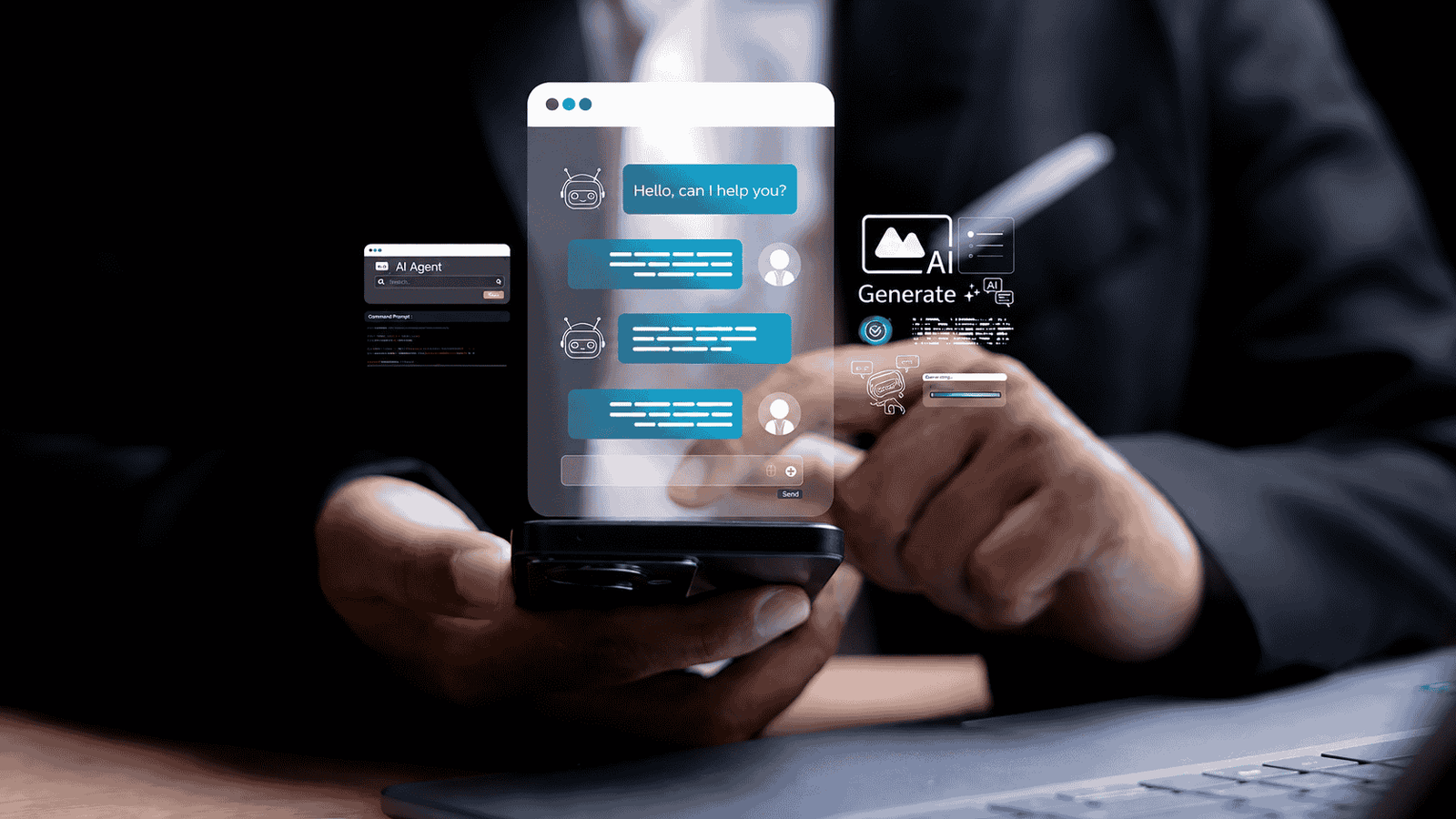
As opposed to the rule-based chatbots, the RAG-powered chatbots do not rely on hard-coded responses. Instead, they have been trained on a particular knowledge base that contains the information that the chatbot is supposed to utilise when responding to customer inquiries. When a customer asks a question, the RAG chatbot searches the knowledge base for relevant information and uses it to formulate a response. It is similar to asking a new customer support agent who knows nothing about the company but has access to the knowledge base documents.
As you can see, the RAG approach has several advantages over the rule-based approach, as it requires less coding to implement and is much more flexible in terms of the types of questions that it can answer. On the other hand, it is much harder to customize a RAG chatbot, as it will always rely on the information contained in the knowledge base. Additionally, while rule-based chatbots are unable to answer unexpected or unrelated questions, RAG chatbots can answer almost any question, provided that the necessary information is contained in the knowledge base. The RAG approach is much less predictable, as the chatbot will provide responses based on the information that has been provided to it.
That being said, the ability to train the chatbot is also a huge disadvantage if the information in the knowledge base is incorrect. The quality of the information provided by the RAG chatbot is only as good as the quality of the information contained in the knowledge base, so it is vitally important to ensure that the training data is up-to-date and accurate. It is much easier to ensure that the rules that a rule-based chatbot follows are consistent and do not provide incorrect information. If you’re ready to build a RAG-powered chatbot, you can get started with OpenAI today. Visit the OpenAI Platform to purchase API credits, access powerful models like GPT-5, and build applications that use Retrieval-Augmented Generation (RAG).
Rule-Based Chatbot vs RAG-Powered Chatbot: Comparison
The information provided below is a general comparison of the two approaches. The table below lists rule-based chatbot vs RAG-powered chatbot in terms of several characteristics.
| Criteria | Rule-Based Chatbot | RAG-Powered Chatbot |
| How it answers questions | Follows hard-coded rules | Searches the knowledge base for relevant information |
| Can handle unexpected questions | No | Yes |
| Effort to implement | High | Moderate |
| Effort to update | High | Low |
| Predictability | Always follows the same rules | Depends on the knowledge base |
| Can handle multiple languages | No | Yes |
| Running costs after implementation | Usually has none | Has a small cost per conversation |
| Best used for | Simple, repetitive tasks | More complex or research-heavy tasks |
| Main weakness | Always follows the same rules | Can provide incorrect information based on the knowledge base |
When Is a Rule-Based Chatbot Better?
When considering the rule-based chatbot vs RAG-powered chatbot dilemma, it is vitally important to ask yourself what you actually need the chatbot for. In some cases, the rule-based approach might actually be a better option, despite being somewhat limited. Below are some of the most common situations in which the rule-based approach is better.
Your task is simple and straightforward
The rule-based approach is best utilized when the task at hand is simple and does not require much context beyond responding to a particular request. A rule-based chatbot is best used when it responds to frequently asked questions in a manner similar to a human customer support agent. This type of chatbot is best used for simple, repetitive tasks that do not require much explanation, such as inquiring about the status of an order or a refund.
You need consistent, identical responses
As mentioned above, the rule-based models always follow the same rules. This means that, if programmed correctly, they can be utilised to provide identical responses to identical questions. This feature might actually be an advantage in some situations, as there is no room for error. Some industries are highly regulated, which means that an AI providing different information than a human employee could actually get the company in legal trouble. If you need an AI agent that will follow the same procedures for every customer without fail, a rule-based bot is actually the best option.
You need to handle high-value or high-risk tasks
Some tasks performed by bots are of a higher value or risk than others. This is especially true for tasks that require customer support, such as providing assistance with account management. Such tasks often involve the exchange of sensitive or personal information. When it comes to such tasks, a rule-based agent is actually the best option. This is because rule-based agents are completely predictable, which means that there is no chance that they will make a mistake when it comes to sensitive or personal information. Any error on the agent’s end could result in a data breach that would endanger the safety of your customers and your company.
Your customers only ask a few different types of questions
When it comes to implementing agents, it is always important to consider whether your customers even need them in the first place. If your customers only ask a few different types of questions, it might not be worth using a RAG , as it would be much more expensive than a rule-based model.
When Is a RAG Chatbot Better?
For most business owners, the rule-based bot vs RAG-powered agent dilemma does not even exist,
In most cases, you are only considering implementing a chatbot to begin with because you need it to handle complex or unpredictable tasks. This is exactly what the RAG chatbots are best at responding to unpredictable or unique customer inquiries.
Your catalog or documentation is large or complex
A rule-based model would have to be programmed to answer every possible question that a customer might ask, while a RAG can be trained on a large body of documentation, providing it with access to the information that it needs to answer questions. For instance, if you have a large knowledge base that contains the information that your customer support agents use when responding to customer inquiries, you can utilise a RAG to allow customers to search this knowledge base on their own. In most cases, a RAG will be able to do this much more efficiently than a rule-based bot.
Your customers ask questions in their own words
The effectiveness of a rule-based agent is largely determined by how much effort has been put into coding it. If you have spent significant amounts of time and money coding a agent, it should be able to handle a large variety of questions. However, if a customer asks a question that a rule-based bot is not programmed to answer, the bot will not be able to provide a satisfactory response. At the same time, the RAG approach is much better at answering questions that customers ask in their own words.
Your documentation is constantly changing
If you need to update your documentation frequently, a RAG agent will be much more effective at utilising the knowledge base to answer customer inquiries. This is because you will not have to update the model itself, as it only draws information from the knowledge base. At the same time, with a rule-based bot, you will have to update the bot every time you need to update your documentation.
You need to support multiple languages
If you need to support multiple languages, a RAG model will be a much better option, as it can be trained to understand and respond to requests in multiple languages, while a rule-based bot would have to be programmed separately for every language that it needs to support.
You need to reduce the workload of your customer support team
A RAG agent can be utilised to deflect customers who ask unique and unpredictable questions, which means that a RAG agent can be much more effective at reducing the workload of your customer support team.
The Hybrid Approach
The majority of rule-based and RAG are, in fact, hybrid systems that utilise both approaches. Most commonly, such bots use either a menu or a search bar to let customers ask the questions that they need. In response to relatively simple questions, the agent will rely on the rule-based approach, whereas for more complex requests, it will utilise the RAG approach to search for answers.
By utilizing a hybrid approach, the chatbot designer can obtain the main advantages of both methods. First and foremost, since the rule-based element will handle most of the requests, the hybrid chatbot will be much easier to maintain and update than a fully-featured RAG chatbot. Additionally, if the chatbot handles complex or unique requests utilizing the rule-based approach, it will be able to ensure maximum predictability when it matters most.
Using a hybrid approach is also a great way to enforce certain rules within the chatbot. For instance, if the customers ask a question that requires the chatbot to gather sensitive information, it will utilize the rule-based approach to ensure that no irrelevant information is processed.
How Much Does It Actually Cost?
When comparing rule-based chatbot vs RAG-powered bot, the question of costs is one of the most important ones. The good news is that, when it comes to costs, there is an advantage to both approaches.
A rule-based chatbot will typically have lower initial costs, as a RAG requires much more coding to be implemented. In most cases, a rule-based bot will only cost a few thousand dollars to implement a very reasonable price for a tool that can deflect a large number of customer inquiries. On the other hand, a similarly simple RAG will typically cost much more to develop.
On the other hand, the per-interaction costs of the RAG will almost certainly be lower than those of a rule-based chatbot. This is because most RAG chatbots utilise a language model with a per-interaction fee, while most rule-based bots typically do not have any additional costs after development.
When it comes to maintenance, a rule-based chatbot will typically have much higher costs than a RAG . This is because a RAG only needs to have its knowledge base updated, whereas a rule-based bots will typically need to be updated manually every time there is a change in the information that it provides. In most cases, RAG’s have lower maintenance costs and are thus a much better option for small and medium-sized businesses in the long run.
If your business relies heavily on phone calls instead of website chats, an AI voice agent may provide a better return on investment. Read our guide on AI voice agents to learn how they answer calls, qualify leads, schedule appointments, and automate customer conversations.
When comparing a RAG-powered bots with a rule-based chatbot, it’s important to consider the long-term impact on your business. A AI agent should reduce operational costs by handling customer inquiries efficiently and easing the workload of your support team. Rule-based bots are limited to predefined responses, so they often fail when customers ask unexpected questions, leading to more support tickets and higher costs. In contrast, a RAG-powered solution can answer a much wider range of queries using up-to-date information, helping resolve more conversations successfully and delivering greater value over time.
A Checklist to Help You Choose
Most customer questions fall into a limited number of categories. If your customers typically ask only a few different types of questions, a rule-based chatbot will be much more cost-effective than a RAG model.
You have a limited number of products, services, or policies. If you only offer a limited number of products, services, or policies, a rule-based bot will be much more cost-effective than a RAG model.
You need to support only one language. If you only need to support one language, a rule-based bot will be much more cost-effective than a RAG bot.
You have limited resources to maintain the chatbot. If you have limited resources to maintain the bot, a RAG models are much more cost-effective than a rule-based bots.
You operate in a highly regulated industry. If you operate in a highly regulated industry, a rule-based bot is much more cost-effective than a RAG bots.
Frequently Asked Questions
Is a rule-based chatbot a good choice in 2026? A rule-based bot can still be useful in limited circumstances, but it is much more limited and less flexible than it used to be. It should only be used in situations where the task is very simple and predictable.
Can a RAG model replace my customer support team? No, but it can help deflect customers who ask routine questions, reducing the workload of your customer support team.
Does a RAG bot prevent the bot from giving false or misleading information? It reduces the risk, but it does not eliminate it entirely. In most cases, however, the source of false or misleading information in a RAG is incorrect or out-of-date information in the knowledge base. For this reason, RAG is not a good choice for sensitive applications where false information could cause serious harm.
Can I use both a rule-based bot and a RAG , or switch from one to the other? Yes, in fact, most chatbots are actually hybrids that use elements of both approaches. It is also entirely reasonable to start with a rule-based bot and switch to a RAG later.
How long does it take to build and launch a chatbot? It depends on the complexity of the chatbot, but a simple rule-based bots typically take only a few days to a few weeks to launch. RAG typically takes much longer to build and launch, especially if it is designed to handle complex or unique questions.
Do I need to inform customers that they are interacting with an AI chatbot? In most cases, yes and this is actually a legal requirement in many jurisdictions. In general, it is always a good idea to be transparent about the fact that a chatbot is not a real person, because this helps build trust with your customers.
Which industries can benefit from using chatbots? Most industries that rely on customer support can benefit from using bots, but they are most useful in industries where customer inquiries are frequent and relatively straightforward. This includes e-commerce, SaaS, healthcare, and insurance, among others. Chatbots can help deflect routine customer inquiries, reducing the workload of customer support teams and improving the customer experience.
What if I do not have a knowledge base to train a RAG on? Most companies have some information that can be used to train a RAG bot. If you do not have a knowledge base or documentation that can be used to train a RAG bot, you will need to build one, which will take some time and effort.
Want more practical AI tips, chatbot insights, and automation strategies? Follow us on Facebook and Instagram for the latest guides, industry updates, and real-world AI solutions for growing businesses.
Liked what you read? This is just a glimpse of how we think. Reach out and let’s talk about what we can build for your business.
Contact Us